by Hayley Lewis
Ward Pound Ridge Reservation’s diverse ecosystems provide ample habitat for a wide variety of avian species, with our meadows in particular being known for our abundance of Eastern bluebirds and tree swallows.
Both species, known for their vibrant blue hues and beautiful songs, happen to have particular nesting requirements that require active conservation efforts to fully support. Both Eastern bluebirds and tree swallows are known as cavity nesting songbirds, while this nesting behavior usually requires the breeding couples to find hollows within dead standing trees (often called snags) to safely build their nests and raise their broods within. The unique habitats found within tree snags are seldom found in the abundance and preferred nesting orientation to allow large bluebird and tree swallow populations to zero, with no mammalian or reptilian proliferate. The lack of suitable nesting locations is in large part due to human development and habitat fragmentation.
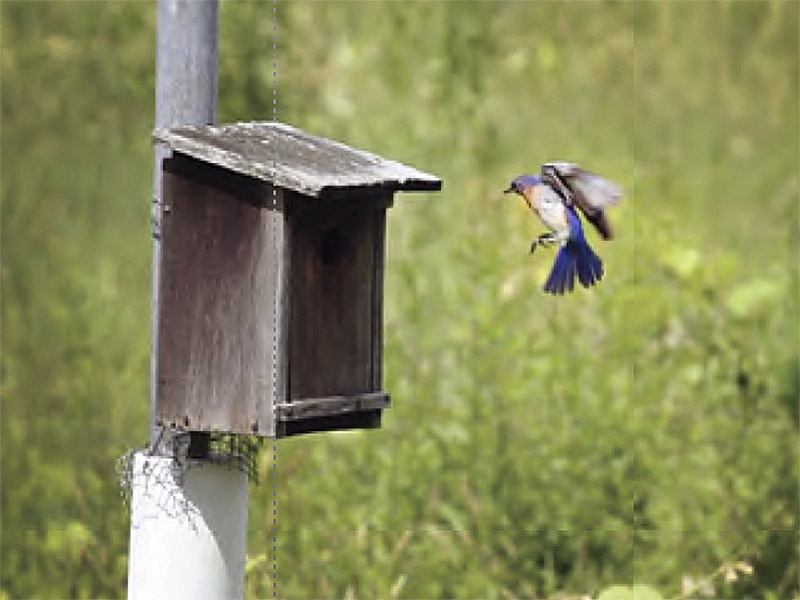
Ward Pound Ridge Reservation has been working hard to compensate for lost habitat through construction and monitoring of artificial nesting sites since the 1970s. The nest boxes seen throughout our Reservation today are a current continuation of this longstanding conservation tradition, which has yielded consistent results over the past several years in terms of allowing sizeable populations of bluebirds and tree swallows nesting, reproducing, and rearing their young to fledging within the meadows of the Reservation.
Over the past 3 years, our site had boasted a robust survival rate, averaging at approximately 71% overall. Our most recent year yielded 18 total recorded nesting attempts for Eastern bluebirds and 7 tree swallow nesting attempts over the breeding season. These nesting attempts yielded 119 total eggs laid, 112 of which hatched, and 85 of which survived to their fledgling stage. While there have been mild fluctuations in the past years regarding species composition, and egg to fledgling success rates, the overall occupancy of our nesting sites have greatly improved when compared to prior decades of monitoring.
In prior years, the nesting behaviors and success were more heavily limited due to access to predators, primarily due to historic nest sites prior to 2009 were primarily mounted on trees within the Reservation’s meadow borders. While tree mounted nest boxes sadly yield access for predators such as raccoons, snakes, and luckily, with the standalone structures and predator deterrent baffles implemented currently, mammal and reptile predation has decreased to near zero, with no mammalian or reptilian predation being recorded in the past 3 years. As of now, the largest threat to bluebirds and tree swallows nesting throughout the Reservation is due to other avian competition, likely due to house wrens and sparrows, which is being mitigated as much as possible through selective placement avoiding hedgerows and shrub lines where these non-target species tend to be most active and abundant.
View our full Winter 2026 Newsetter (PDF)